


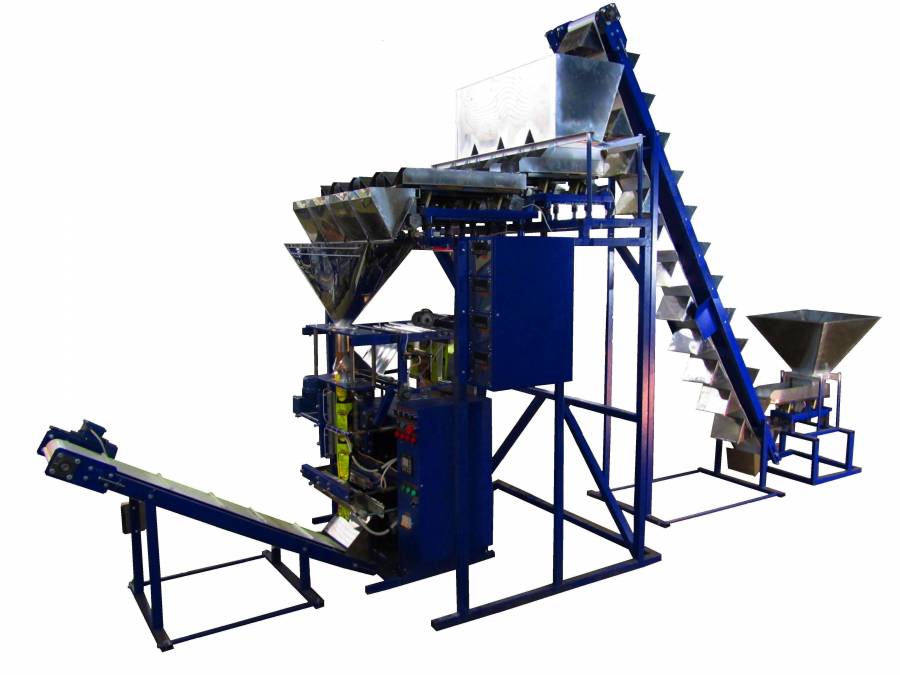
Chips (from chip – shavings) – a snack consisting of thin slices of potatoes (less often – other root vegetables or various fruits), usually fried in oil (deep fat). Sold as a ready-to-eat food product. Refers to the snack group, i.e. to light dishes intended for a “snack” – to satisfy hunger between main meals.
Additional information
Characteristic
In the vast majority of cases, chips are sold in pillow bags. The only exceptions are Pringles, for which tube packaging has become a kind of calling card, and flat chips (the so-called “potato wafers”), which are simply impossible to pack in a pillow bag (cardboard boxes are used for their packaging). That is why we will talk exclusively about equipment designed for packing chips in pillow bags.
The peculiarity of packing chips is that, firstly, chips are a conditionally loose product, and, secondly, they are quite fragile. Conditional flowability is due to the shape and is manifested in an unpredictable amount of chips poured out: clinging to each other, they may either not spill out at all, or pour out in lumps (heaps), or pour out in a uniform stream. It is extremely difficult to guess what and when will happen. Therefore, volumetric dispensers cannot be used for packing chips – in them, the chips will not evenly fill the dosing cavities (volumes) and will crumble with the slightest effort.
Only weigh batchers should be used for packing chips. Moreover, taking into account the conditional flowability of chips, the weigh batcher should be two-level, that is, have two vibrating trays located one above the other. In this case, the chips, pouring out of the bin, will move along the upper vibrating tray, separating from each other under the action of vibration, pour into the lower tray, separating even more, and, moving along the lower vibrating tray, pour into the bucket in individual chips, eliminating deviations in doses.
Chips can be packed both automatically and semi-automatically. The first method requires the purchase of expensive equipment (vertical packing machines), but in the future all operations will be performed automatically, with a given accuracy and high productivity. The second method saves the budget (the price of the equipment is much lower), but requires constant and active human participation in the packing process. Also, with the second method, the packing productivity is much lower than with the first.
Automatic packaging
For automatic packing of chips it is necessary:
The packing machines that can handle packing chips in a “pillow” bag are:
The difference between the proposed machines will consist only in the type of packaging component. And you can read about this in the FAQ “Which machine to choose: pneumatic, mechanical or pneumomechanical”.
It is also desirable to provide the ability to remove finished packages from the machine. Otherwise, falling on the floor or on each other, they can damage the chips packed in them. As an option, you can use the OT-1 diverting conveyor
Semi-automatic packaging
For semi-automatic packing of chips, you need everything the same as for automatic packing, except for the packing machine. Instead, you can use a semi-automatic packing machine, which, although it requires constant operator participation in its work, is several times cheaper than the machine.
Such a packing semi-automatic machine can be a packing semi-automatic machine with a weigh batcher PAF-20-V, if, of course, it is equipped with a two-level batcher (manufactured to order).
As in the situation with automatic packing, it is necessary to think over the filling of the bunker of the packing semi-automatic machine (manually or purchase a loading conveyor) and provide for the removal of finished packages.
Possibilities
up to 2,000 packs/hour
Type of packaging
package (pillow/standing)
Types of films
any except PVC, POF, PE